
Outdoor Storage
Views: 0 Author: Site Editor Publish Time: 2026-07-27 Origin: Site


Lawn equipment, seasonal gear, and power tools degrade rapidly when exposed to weather. Storing these items in the garage often leads to clutter, displacing vehicles and creating disorganized workspaces. Homeowners and property managers face a specific spatial dilemma: over-investing in a massive structure that triggers zoning headaches, or under-investing in a unit that fails to house essential, bulky equipment. Choosing between a cabinet vs shed depends heavily on your available footprint, specific inventory dimensions, and installation bandwidth. This guide provides a technical evaluation framework to determine which structure yields the highest return on your spatial investment for specific property constraints. We will look at site preparation, material durability, and structural limitations to help you make the right call for your yard.
Capacity vs. Footprint: Outdoor cabinets maximize vertical organization in tight spaces (patios, side yards), while sheds offer walk-in volume for bulkier items (riding mowers, workbenches, adult bicycles).
Compliance and Preparation: Sheds frequently require level foundation pouring, building permits, and HOA approval; cabinets are generally classified as temporary furniture and bypass these hurdles.
Material Trade-Offs: Both solutions require material evaluation (resin, vinyl, wood, metal) balancing upfront cost against long-term maintenance, fire hazard ratings, and weather resistance.
Total Cost of Ownership: The true cost of a shed includes foundation materials, anchoring kits, potential permit fees, and higher assembly labor, whereas a cabinet is typically a flat, upfront expense.
Table of Contents
Categorize your items by dimension, weight, and access frequency before selecting a structure. You need to know exactly what you are storing to avoid buying a unit that is either too small or unnecessarily large. Differentiate between long-handled tools, pool chemicals, and small gardening supplies versus wheeled equipment and bulk materials. A cabinet handles vertical, lightweight storage exceptionally well. You can easily organize fertilizers, hand trowels, pruning shears, and extension cords on adjustable shelves. Most vertical units come with molded shelf supports that let you customize the interior layout based on the height of your items.
Conversely, a shed becomes mandatory when your inventory includes riding lawnmowers, snowblowers, wheelbarrows, or large stacks of firewood. You must account for the footprint of these items when they are parked, plus the clearance needed to maneuver them in and out. Consider the weight of your inventory as well. Bags of potting soil, concrete mix, and rock salt add up quickly. Standard plastic shelving inside smaller units will bow and eventually collapse under heavy point loads. If you plan to store heavy bags, you need a structure that allows you to stack them directly on a reinforced floor or a concrete slab.
Evaluate your primary installation site with a tape measure. Do not guess the dimensions. Measure clearance for doors swinging open, roof overhangs, and setback rules dictating distance from property lines. Leveling tolerances play a massive role here. A small patio might perfectly accommodate a vertical storage unit without any ground modification. You just set it down, check for plumb, and load it up. Larger structures demand significant flat terrain. You cannot install a 10x12 outbuilding on a slope without building a substantial retaining wall or a raised floor frame.
Failing to account for overhead tree branches or underground utility lines during this phase guarantees installation delays. Look up and look down. If you place a structure under a mature oak tree, you will deal with constant debris on the roof, potential branch damage during storms, and sap ruining the exterior finish. If you build over a utility easement, the city or utility company has the legal right to tear down your structure to access their lines. Always call your local utility marking service before digging any foundation.
Assess the value of the stored inventory to determine necessary locking mechanisms and structural rigidity. High-value power tools require reinforced doors and heavy-duty padlocks. Flimsy plastic doors with simple hasps offer zero resistance to a determined thief with a pry bar. If you store expensive chainsaws, generators, or commercial landscaping equipment, you need a structure with solid doors, hidden hinges, and the ability to mount a hardened steel lock.
Consider fire safety codes if you plan to store volatile chemicals, gasoline, or lithium-ion batteries. Proper ventilation prevents the buildup of dangerous fumes. A sealed plastic box sitting in the summer sun turns into an oven, which can cause fuel cans to expand and vent vapors. Anchoring requirements also scale with the size of the unit and local wind conditions. You must decide whether you need simple wall tethers to keep a tall unit from tipping forward, or deep concrete anchors to keep a large outbuilding from lifting off the ground during a severe storm.
Define the limit where neither on-site option works. Extreme volume requirements or severe Homeowner Association (HOA) bans sometimes make renting an off-site self-storage unit a more flexible, viable alternative. If you own commercial-grade landscaping equipment but live in a community with strict outbuilding prohibitions, a permanent backyard installation will only result in fines and forced removal. Sometimes, the logistics of site preparation, permitting, and construction outweigh the convenience of having the items on your property. Recognize when your storage needs have outgrown your residential footprint.
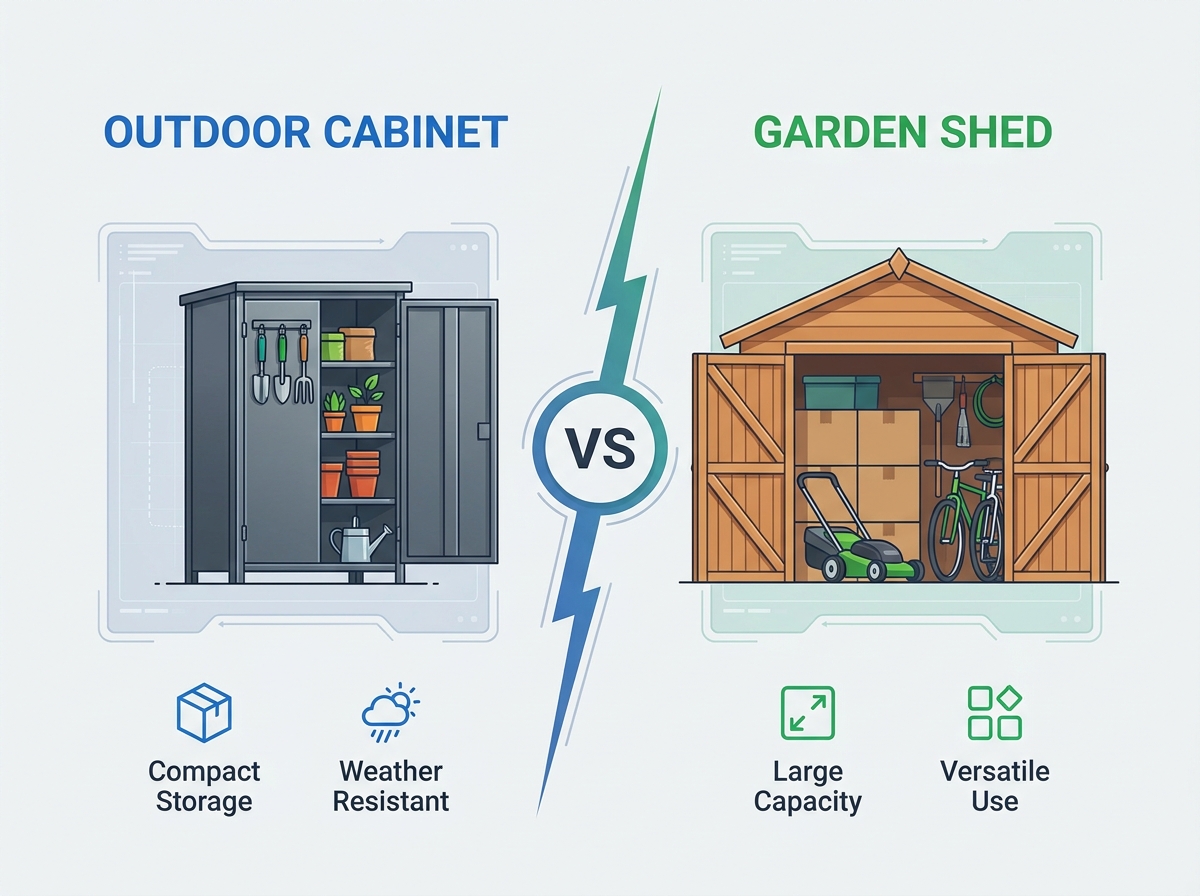
Vertical storage units offer a zero-footprint impact. They fit perfectly on balconies, narrow side yards, and patios requiring immediate access. You do not need to sacrifice a large portion of your lawn to gain valuable storage space. Organizational efficiency stands out as a primary benefit. Built-in shelving accommodates gardening supplies, pool chemicals, and handheld power tools seamlessly. You can open the doors and immediately see everything you own without having to step inside and dig through piles of equipment.
The plug-and-play nature of these units appeals to many users. You face minimal assembly times. Most models snap together with a few screws for reinforcement. You rarely need to pour a foundation beyond ensuring a flat paver or existing concrete pad sits beneath the unit. This makes them ideal for renters or homeowners who want a quick weekend project without the hassle of mixing concrete or framing a floor.
You will encounter hard limits on internal volume. Most units max out around 70 to 100 cubic feet. You cannot store wide-deck lawnmowers, adult bicycles, or large backup generators inside them. The depth restricts you to single-row storage for larger items, meaning you must remove front items to access anything stored in the back. This can become frustrating if you frequently need access to items stored in the rear corners.
Weight limits on internal shelving also restrict how many heavy bags of soil or rock salt you can store simultaneously. Check the manufacturer's weight rating for each shelf. Overloading plastic shelves causes them to warp, which can push the side walls outward and prevent the doors from closing properly. If the doors do not align, the unit loses its weather resistance, allowing rain and pests to enter.
The material you choose dictates how long the unit will last and how much maintenance it requires. Manufacturers use several different materials, each with distinct advantages and drawbacks.
Material | Durability | Maintenance | Best Use Case |
|---|---|---|---|
Resin / HDPE | High UV resistance, zero rot. Can warp under extreme heat if overloaded. | Low. Wash with a hose and mild detergent. | General yard tool storage in moderate climates. |
Vinyl (PVC) | Highly durable, fire-retardant, will not rust or rot. | Zero maintenance. Cannot be painted easily. | Storing pool chemicals or items near heat sources. |
Wood | Excellent structural rigidity. Vulnerable to moisture and pests. | High. Requires annual sealing, staining, or painting. | Matching existing outdoor furniture or deck aesthetics. |
Resin and High-Density Polyethylene (HDPE) provide excellent UV resistance and zero rot. They remain lightweight but can warp under extreme heat if you overload the shelves. Vinyl (PVC) offers high durability, fire-retardant properties, and a maintenance-free lifespan. It will not rust or rot, though you sacrifice paint and aesthetic customization. Wood integrates beautifully with existing outdoor furniture but demands annual sealing and staining to prevent moisture damage and rot. If you neglect wood, it will deteriorate rapidly when exposed to rain and ground moisture.
Walk-in accessibility transforms how you interact with your stored items. You gain multi-functional potential, combining storage with a workspace, potting station, or hobby studio. You can stand up inside, move around, and organize items on multiple walls. High-volume capacity ranges from compact 4x6 lean-tos to massive 12x24 structures. This vast space easily houses ATVs, riding mowers, and bulk seasonal decorations.
You can install overhead lofts, heavy-duty pegboards, and custom workbenches to maximize every square inch. The ability to customize the interior makes these structures incredibly versatile. You can run electrical wiring for lighting and power tools, install windows for natural light, and add ramps for driving heavy equipment directly through the double doors.
You must dedicate significant yard space for these permanent or semi-permanent footprints. Once you build it, moving it requires heavy machinery or complete disassembly. Assembly complexity increases drastically compared to smaller units. You need multiple people, specialized tools, and a significant time investment spanning several days. You will be dealing with hundreds of screws, heavy roof panels, and complex door alignments.
Site preparation demands rigorous attention to detail. An unlevel base will cause doors to stick and roofs to leak over time. If the foundation is off by even half an inch, that discrepancy multiplies as you build the walls, resulting in a roof that does not fit properly. You must invest time and effort into creating a perfectly level, stable base before you even open the boxes containing the structure.
The material selection for larger outbuildings impacts the structural integrity, security, and longevity of the building. You must match the material to your local climate and your willingness to perform ongoing maintenance.
Material | Pros | Cons |
|---|---|---|
Metal / Steel | High security, fire-resistant, impervious to pests. | Prone to condensation, denting, and rust if scratched. Requires strict anchoring. |
Wood | Classic aesthetic, highly customizable, excellent structural integrity. | High maintenance, vulnerable to rot, termites, and fire. |
Resin | Low maintenance, easy assembly, rot-proof. | Difficult to drill into walls for heavy shelving. Can become brittle in extreme cold. |
Vinyl | Superior durability, built-in fire retardancy, excellent wind/snow load resistance. | Higher upfront investment. Limited color options. |
Metal and steel options provide high security and fire resistance. However, lightweight metal requires strict structural anchoring and remains prone to condensation, denting, and rust if scratched. Wood offers a classic aesthetic and high structural integrity. You can customize wood extensively, but it requires high maintenance to fight off pests, moisture, and fire risks. Resin provides a low-maintenance, rot-proof solution with easy assembly, though drilling into walls for heavy shelving proves difficult. Vinyl delivers superior durability, built-in fire retardancy, and excellent resistance to wind and heavy snow loads compared to standard resin.

Compare the unboxing-to-use timeline. Smaller vertical units take one to three hours to assemble using basic hand tools. You usually just need a power drill, a level, and a rubber mallet. Larger outbuildings demand intensive foundation requirements. You must prepare gravel pads, pour concrete slabs, or build treated wood frames. Skipping foundation prep leads directly to structural failure, sagging roofs, and misaligned doors.
Building a proper foundation involves several critical steps that you cannot rush. If you choose a gravel pad, you must execute the following process to ensure stability:
Excavate the topsoil down to a depth of at least four inches, ensuring the excavated area extends one foot beyond the dimensions of the structure on all sides.
Lay down heavy-duty, commercial-grade landscape fabric to prevent weed growth and keep the gravel from sinking into the mud over time.
Construct a perimeter frame using pressure-treated 4x4 lumber, securing the corners with heavy-duty exterior screws or rebar driven into the ground.
Fill the frame with crushed stone (typically 3/4-inch clean stone), spreading it evenly across the entire area.
Tamp the stone down using a plate compactor or a heavy hand tamper, checking multiple points with a long level to ensure a perfectly flat surface.
Lightweight metal, vinyl, and resin structures must be securely anchored to their foundations to prevent catastrophic wind-lift damage during storms. If you build on a concrete slab, you will use masonry anchors. If you build on a wood frame or gravel pad, you must use earth augers driven deep into the soil and attached to the frame of the building with steel cables.
Legal distinctions separate these two options. Smaller units generally classify as temporary furniture, exempting them from local zoning laws and HOA visual guidelines. Because they sit below the fence line, neighbors cannot see them, and they do not alter the permanent footprint of the property. You can usually place them anywhere in your yard without asking for permission.
Larger outbuildings trigger standard restrictions. You must navigate setback rules dictating the exact distance from your fence line, property line, or primary residence. Height restrictions often apply, limiting how tall the roof peak can be. Exceeding specific square footage thresholds (often 100 to 120 square feet) mandates a municipal building permit and subsequent inspections. You will likely need to submit a site plan showing the exact location of the structure, the materials used, and the foundation type. Failure to obtain the proper permits can result in heavy fines and a mandate to tear down the building.
Evaluate the complete investment beyond the initial purchase. Smaller units represent a flat, upfront expense with negligible ongoing costs. Once you assemble it, you rarely need to spend another dime on it. Larger structures involve hidden implementation requirements that significantly increase the overall expenditure.
You must account for site leveling materials, such as tons of crushed stone, pressure-treated lumber, or concrete delivery. Heavy-duty anchoring kits add to the materials list. Delivery fees for oversized freight can be substantial, especially if the truck cannot access your driveway easily. You also face ongoing maintenance supplies like exterior paint, caulk, or replacement shingles for wood models. Permanent structures may also trigger property tax reassessments depending on your local municipal codes, as they add taxable value to your property.
Condensation buildup in metal structures or water ingress in poorly sealed units ruins expensive power tools rapidly. When warm, moist air hits the cold metal roof of an uninsulated building, it condenses and drips down onto your equipment. Mitigate this risk by installing passive vents on opposite gable ends to ensure cross-airflow. This allows the moist air to escape before it condenses.
Use heavy vapor barriers under foundations to block ground moisture from rising into the structure. If you pour a concrete slab, lay a 6-mil plastic sheet over the gravel before pouring the concrete. Apply high-quality exterior silicone sealant to all panel joints, screw heads, and window frames during assembly to create a watertight envelope. Check the weatherstripping around the doors annually and replace it if it becomes brittle or torn.
High winds easily tip over lightweight vertical units or lift unanchored metal and resin structures entirely off their bases. A strong gust of wind catching an open door can tear the hinges right out of the plastic walls. Anchor smaller units directly to exterior brick or concrete walls using masonry screws and heavy-duty L-brackets. Make sure you hit a stud if anchoring to a wood-framed wall.
For larger structures, strictly utilize manufacturer-approved ground augers or concrete anchor kits. Do not rely on the weight of the stored items to hold the building down. Verify the wind load rating of your chosen model matches the historical weather patterns of your geographic region. If you live in a hurricane-prone area, you may need to install additional hurricane ties connecting the roof trusses to the wall panels.
Storing highly flammable fuels, propane tanks, or lithium-ion batteries in non-ventilated or highly combustible wooden structures creates a severe hazard. A single spark from a faulty battery charger can ignite a wooden building in minutes. Select fire-retardant vinyl or metal structures if you plan to store volatile materials. These materials will not add fuel to a fire.
Use spark-resistant rubber flooring mats near fuel storage areas to prevent static discharge. Implement dedicated, vented chemical storage lockers within larger structures to isolate hazardous materials from general inventory. Never store chlorine pool chemicals next to petroleum-based products, as the fumes can react and cause spontaneous combustion. Always keep a rated fire extinguisher mounted near the door for immediate access.
Choosing between an outdoor cabinet and a storage shed depends on the size of your equipment, available installation space, local regulations, and long-term storage requirements. Evaluating these factors before purchasing will help you select the most practical and cost-effective outdoor storage solution for your property.
About KENDA
KENDA specializes in high-quality outdoor storage solutions, including durable storage sheds and outdoor storage cabinets designed for residential and commercial applications. By combining weather-resistant materials, practical designs, and reliable construction, KENDA helps customers create organized, secure, and long-lasting outdoor storage spaces.
Audit the size and type of items you need to store before selecting a storage solution.
Measure your available installation space and check local zoning or HOA requirements.
Choose materials that match your climate, maintenance expectations, and security needs.
Consider both the initial investment and long-term ownership costs before making a decision.
Before choosing an outdoor cabinet or storage shed, compare your storage capacity requirements, installation conditions, local regulations, and future expansion needs to ensure the best long-term value.
A: Standard push mowers with folding handles can fit into deeper vertical units. Riding mowers and wide-deck commercial push mowers require the walk-in footprint and double doors of a larger outbuilding.
A: Generally, no. Most municipalities classify units under a certain height and footprint as temporary outdoor furniture, bypassing permit requirements and setback rules entirely.
A: Install gable vents to promote cross-ventilation, lay a plastic vapor barrier under the foundation before building, and avoid storing wet equipment or damp firewood inside the structure.
A: Resin provides basic security. While doors can be padlocked, the plastic hinges and hasps can be bypassed by determined thieves with pry bars. Store high-value items in reinforced metal or wood structures.
A: No. Direct ground contact guarantees rapid wood rot and termite infestation. Always build on a treated wood skid system, a properly leveled gravel pad, or a poured concrete slab.
A: Vinyl and high-density resin perform best in coastal areas. They completely resist the corrosive effects of saltwater air that rapidly degrades metal components and hardware.


