
Outdoor Storage
Views: 0 Author: Site Editor Publish Time: 2026-07-27 Origin: Site


Many homeowners experience the frustration of buying an outdoor storage solution only to find out their patio cushions must be crushed to fit, or their long-handled tools prevent the doors from closing. This common buyer's remorse stems from a disconnect between manufacturer specifications, often listed in gallons or cubic feet, and the physical realities of backyard inventory, which includes awkward shapes and rigid items. Choosing the wrong outdoor storage cabinet size leads to compromised weatherproofing, wasted patio space, and damaged goods.
To avoid these pitfalls, you need a systematic, inventory-first evaluation framework. By translating your physical storage needs into exact cabinet dimensions, you can ensure a precise fit for both your items and your outdoor footprint. This guide breaks down the exact steps to determine the perfect capacity for your backyard setup.
Inventory Dictates Volume: Sizing must begin with a physical audit of the items being stored, not the available patio space, to prevent purchasing inadequate capacity.
Internal vs. External Dimensions: Manufacturer footprint dimensions do not equal usable space; material thickness and internal hardware significantly reduce actual storage capacity.
The 15% Buffer Rule: Always calculate required volume and add a 10-15% buffer to account for awkward item stacking, future purchases, and necessary airflow to prevent mildew.
Form Factor Matters: An upright outdoor storage cabinet utilizes vertical space for smaller footprints, whereas horizontal deck boxes require larger ground clearance but accommodate bulkier items.
DIY vs. Prefabricated Sizing: Building a custom DIY outdoor storage cabinet allows for tailored dimensions to fit specific awkward tools, whereas retail prefabricated cabinets require matching your inventory to fixed, standard market sizes.
Table of Contents
A successful outdoor storage purchase means zero water ingress, easy retrieval of items, seamless integration into patio aesthetics, and no warping from overstuffing. Achieving this requires precise sizing based on your actual needs. When you buy a unit based solely on how it looks on the deck, you ignore the functional mechanics of storage.
Forcing items into a cabinet that is too small compromises door seals and breaks hinges. Resin and plastic panels flex when under pressure from the inside. If you shove a slightly oversized lawnmower into a plastic shed and force the doors shut, the constant outward pressure warps the door frames. This inevitably leads to moisture or rodent damage. Once a door seal bows outward by even a quarter of an inch, rain gets driven inside during storms, and mice find an easy entry point.
Conversely, buying excessively large units wastes square footage on small decks, allows items to shift and break, and results in unnecessary financial expenditure. A massive shed on a small suburban patio dominates the visual space. Furthermore, tall, empty cabinets act like sails in high winds if they lack the internal weight to anchor them down.
Sizing Error | Physical Consequence | Long-Term Damage |
|---|---|---|
Under-Sizing (Overstuffed) | Bowed doors, stressed hinges, compressed fabrics | Water ingress, moldy cushions, broken latches, rodent entry |
Over-Sizing (Excess Space) | Wasted patio footprint, items falling over inside | Wind vulnerability, inefficient use of deck real estate |
Ignoring Internal Dimensions | Rigid tools block doors from closing | Inability to lock the unit, exposure to elements |
Before looking at cabinet dimensions, categorize and measure the items you plan to store. This inventory dictates the required size and configuration. Grab a tape measure, a notepad, and pull everything you want to store out onto the lawn.

Hand tools, gardening supplies, pool chemicals, and grilling accessories require specific organization. You cannot just pile these into a large box. Note the necessity of adjustable shelving for these items to maximize vertical space without wasting capacity.
Group all small items by category (e.g., pool, garden, grill).
Measure the tallest bottle of chemical or fertilizer you own. This dictates your minimum shelf height.
Count the number of small bins you will use to hold loose items like hose nozzles or work gloves.
Measure standard patio chair cushions, folding chairs, and hoses. Avoid over-compressing fabrics, as a lack of airflow significantly increases mold risk. Measure these items in their relaxed state. If you have six dining chair cushions, stack them up exactly as you plan to store them. Measure the height, width, and depth of the entire stack. Do not assume you can squish a 30-inch stack down to 24 inches. Over time, the foam breaks down, and the lack of air circulation breeds mildew.
Lounge chaise cushions, long-handled tools like rakes and brooms, and heavy equipment such as lawnmowers require ample space. Emphasize measuring the longest rigid dimension to ensure these items fit without obstructing the doors. A standard leaf rake is often 60 to 65 inches long. If you buy a cabinet with an internal height of 58 inches, that rake will never fit unless you cut the handle or store it diagonally, which ruins the storage efficiency for everything else.
Items like birdseed, organic fertilizers, and cushions attract pests. Your inventory's vulnerability to rodents dictates the need for a tightly sealed cabinet size that doesn't compromise joint integrity when fully loaded. If you store birdseed, you need a unit with heavy-duty, lockable doors that sit flush against the frame.
Understanding industry-standard sizing metrics is crucial. Convert internal inches to cubic feet to gauge true capacity. Gallon ratings are often used for horizontal boxes but can be misleading for vertical cabinets. A 100-gallon vertical cabinet might not hold a 60-inch shovel, even though the total volume is large.
Metric | Best Used For | How to Calculate/Understand |
|---|---|---|
Gallons | Horizontal deck boxes, liquid volume equivalents | 1 Cubic Foot = approx. 7.48 Gallons |
Cubic Feet | Overall 3D space inside the unit | (Length x Width x Height in inches) / 1728 |
Linear Inches | Checking fit for rigid, awkward items (rakes, mowers) | Direct tape measure reading of the longest side |
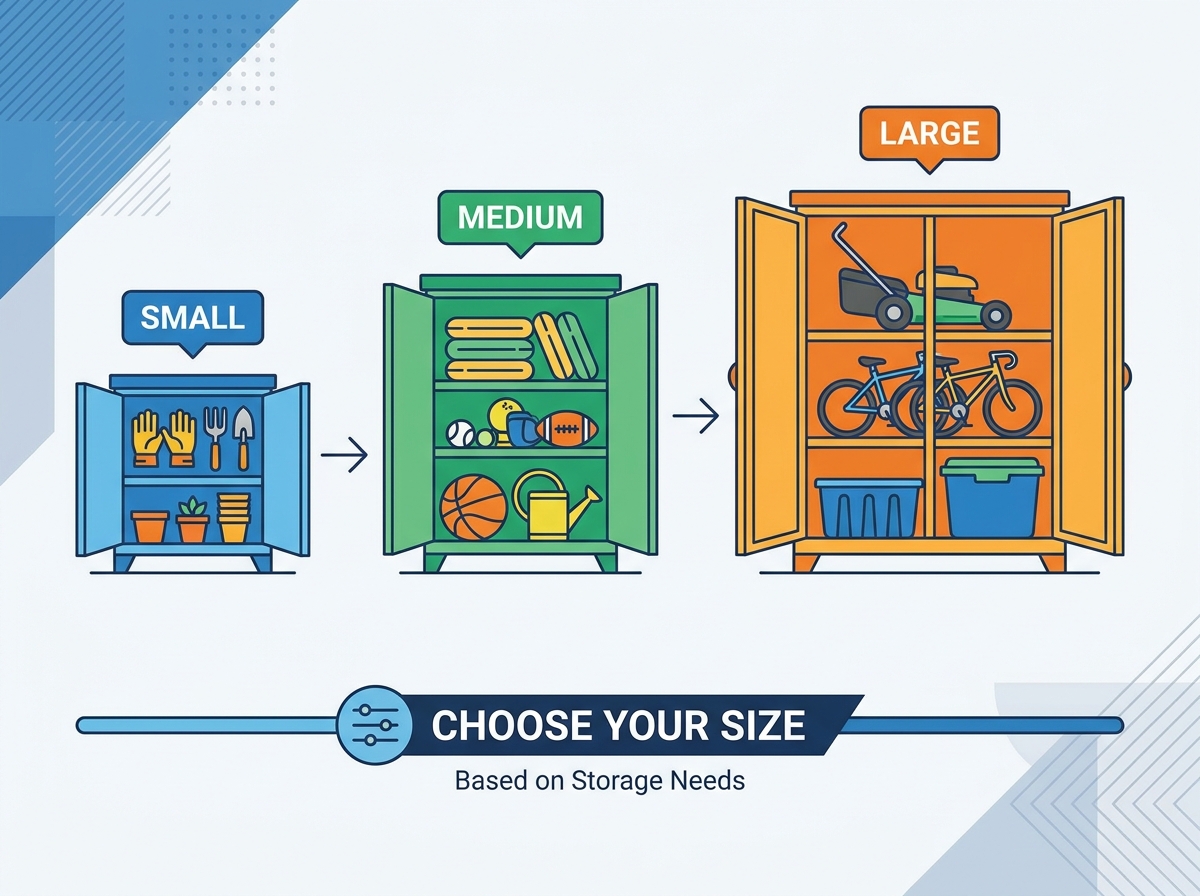
Best for balconies, small patios, storing a few hand tools, outdoor shoes, boots, or single-seat cushions. Typical dimensions are approximately a 2ft x 2ft footprint and under 3ft tall. They cannot hold long-handled tools or full dining set cushions. These units often double as side tables next to patio furniture.
Best for standard patio setups, multiple standard dining chair cushions, pool toys, and gardening pots. Typical dimensions are approximately 3ft to 4ft in width and height. They may struggle with rigid, oversized items unless shelves are removed. This size is the sweet spot for most suburban decks looking to hide clutter.
Best for full sets of patio chair cushions, multiple pairs of outdoor footwear, lawn chemicals, and medium-sized garden gear. Typical dimensions are approximately 4ft to 5ft in height, with depth tailored for deep-seat cushions. Requires careful vertical shelf planning. You will often find double doors on these units to allow wide access.
Best for full multi-piece patio furniture sets, large lounge chaise cushions, long-handled tools, and bulky machinery. Typical dimensions are over 5ft tall with deep footprints. Requires a significant footprint and often a leveled, reinforced foundation. You cannot place these directly on soft dirt; they require pavers or a concrete pad to prevent the base from cracking under heavy loads.
Contrast the spatial efficiency of a tall cabinet against a wide deck box. Maximize cubic volume without sacrificing deck square footage by choosing the right form factor. If you have a narrow side yard, a tall, shallow cabinet works best. If you have a wide, open pool deck, a long, low horizontal box might double as bench seating.
Detail the operational space needed beyond the static footprint. Include measurements for door swing radius, lid clearance, and ergonomic access for the user. If your cabinet has two doors that are each 24 inches wide, you need at least 24 inches of clear space in front of the unit just to open it, plus another 18 to 24 inches for you to stand there and pull items out. Never place a cabinet tight against a walkway where open doors will block foot traffic.
The size and weight of the cabinet dictate placement. Larger cabinets require perfectly level, solid foundations like concrete, pavers, or reinforced decking to prevent structural twisting and door misalignment. If you place a heavy resin cabinet on uneven grass, the base will contour to the ground over time. This twists the side panels, which pulls the roof out of square, meaning your doors will never latch properly again.

Analyze how different materials, such as double-wall resin, solid wood, or metal, impact the ratio of external footprint to internal usable space. Thicker materials reduce internal capacity. A blow-molded resin cabinet might have walls that are 1.5 inches thick. That means you lose 3 inches of total width and depth right off the bat. Always verify the internal dimensions before buying.
Discuss the trade-off between having multiple shelves for organization and open vertical space for large items. Modular or adjustable shelving offers valuable flexibility. Fixed shelves force you to adapt your inventory to the cabinet. Adjustable shelves let you adapt the cabinet to your inventory.
Compare the sizing freedom of building a custom wood cabinet tailored to exact tool lengths against buying prefabricated resin or metal options with standardized, fixed exterior footprints. Custom builds maximize every inch of your specific patio, but require significant labor and maintenance. Prefabricated units are fast to assemble but force you to work within standard market sizes.
Address the compromise between buying a highly stylized, low-profile cabinet versus a utilitarian, maximum-capacity unit based on your primary needs. Wicker-style resin looks great next to outdoor furniture but often sacrifices internal volume for exterior aesthetics.
Packing a cabinet to 100% capacity restricts necessary airflow, leading to condensation, mildew, and musty odors. Size up to allow proper ventilation. Outdoor environments experience massive temperature swings. When the sun hits a sealed plastic box, the inside heats up. When the sun goes down, the air cools rapidly, causing condensation on the inside walls. If your cushions are jammed tight against the plastic, they will absorb that moisture.
Overstuffed cabinets often experience structural bowing at the doors and joints, leaving gaps for rodents to enter. Sizing up ensures door latches lock tightly and maintain pest-proof integrity. Mice can squeeze through gaps as small as a quarter of an inch. A warped door is an open invitation for pests to nest in your expensive patio cushions over the winter.
Detail the risks of overloading shelves in large cabinets. Check manufacturer per-shelf weight limits and anchor tall cabinets to prevent tipping in high winds. Most resin shelves max out around 40 to 50 pounds. Do not stack bags of potting soil or heavy power tools on upper shelves. Keep heavy items on the floor to lower the center of gravity, and always use the provided wall anchors if you live in a high-wind area.
Choosing the correct outdoor storage cabinet size is the key to maximizing storage efficiency while protecting your belongings from weather, moisture, and pests. Measuring your inventory, evaluating your available space, and selecting the right cabinet dimensions will ensure a practical and long-lasting outdoor storage solution.
About KENDA
KENDA is a professional manufacturer of outdoor storage cabinets and storage sheds, offering a wide range of weather-resistant resin storage solutions for patios, gardens, garages, and backyards. With durable construction, practical designs, and easy assembly, KENDA helps homeowners and businesses create organized, low-maintenance outdoor storage spaces.
Measure your largest items before selecting a cabinet size.
Compare internal dimensions instead of relying only on external measurements.
Leave additional space for airflow and future storage needs.
Choose a level installation surface to maintain structural stability and weather resistance.
Before purchasing an outdoor storage cabinet, compare your inventory size, available installation space, internal dimensions, and future storage requirements to select the most suitable cabinet capacity.
A: A medium capacity unit (50-99 gallons) holds standard dining cushions. For full lounge sets or deep-seat cushions, you need a large capacity (100-149 gallons) or extra-large unit. Always measure the stacked cushions first.
A: A deck box is horizontal and opens from the top, ideal for bulky items and doubling as seating. A cabinet is vertical, opens with front doors, and uses vertical space efficiently for smaller footprints.
A: Measure the internal length, width, and height in inches. Multiply these three numbers together, then divide the result by 1,728 to get the cubic feet.
A: Yes, always add a 10-15% buffer to your calculated volume. This prevents overstuffing, allows for necessary airflow to prevent mildew, and accommodates future storage needs.
A: You need a tall unit, typically over 5 feet in height, or an extra-large utility shed. Ensure the internal height accommodates the longest rigid dimension of your tools.
A: Manufacturers typically list external dimensions for footprint planning. Always check the specifications for internal dimensions, as material thickness and hardware reduce the actual usable storage space.


