
Outdoor Storage
Views: 0 Author: Site Editor Publish Time: 2026-08-13 Origin: Site


Purchasing privacy slats without verifying existing fence dimensions routinely results in installation failure, damaged materials, or inadequate privacy coverage. Chain link fences are not universally standardized across residential and commercial properties. Variations in mesh size, wire gauge, physical height, and wire coatings mean that privacy slats are never a one-size-fits-all product. Forcing incompatible slats compromises the structural integrity of the fence under wind load and permanently warps the plastic material. We see property owners make this mistake constantly, ordering bulk materials only to find they will not slide past the first diamond.
This guide breaks down the technical specifications of chain link slat sizes. It provides a strict framework to measure your existing fence, evaluate compatibility, and select the correct slat dimensions for your specific privacy, durability, and environmental requirements.
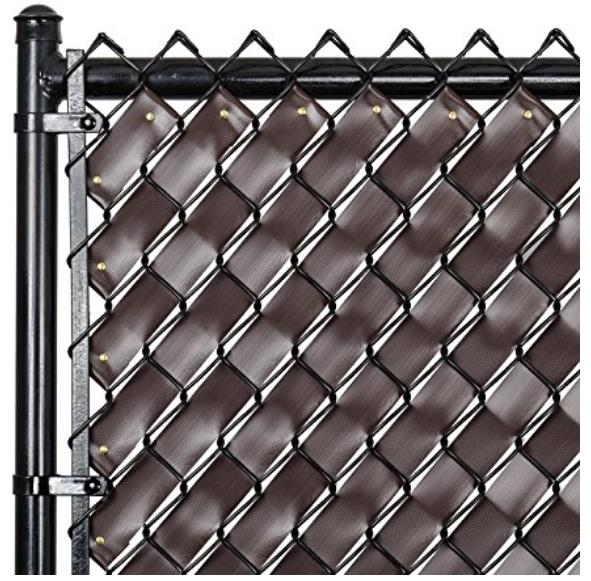
Mesh Size and Gauge Dictate Compatibility: The inside diagonal measurement of the chain link diamond (mesh size) and the thickness of the wire (gauge) are the primary constraints for slat width and insertion clearance.
Actual Slat Length vs. Nominal Fence Height: Slats are intentionally manufactured 3.5 inches shorter than the nominal fence height (e.g., a 72-inch fence requires 68.5-inch slats) to allow for bottom clearance and locking mechanisms.
Privacy is a Function of Fit: Maximum privacy (90%+) requires a precise match between slat width and mesh size; undersized slats in a large mesh will result in significant visibility gaps.
Coatings Alter Clearances: Vinyl-coated chain link reduces the internal diamond clearance compared to standard galvanized wire of the same core gauge, often requiring a narrower slat.
Wind Load Trade-offs: Higher privacy percentages directly increase the wind load on the fence infrastructure, requiring verification of post spacing and footing depth before installation.
Table of Contents
Mesh size represents the internal open space of the chain link fabric, dictating the maximum width of the slat that can pass through the wire matrix. It is defined strictly as the inside distance between two parallel wires in the diamond pattern. Measuring from corner to corner or outside to outside will yield inaccurate dimensions, leading to the purchase of incompatible materials. A mistake of just one-eighth of an inch in your measurement will completely derail an installation project.
To measure the mesh size accurately, follow these field-tested steps:
Locate a section of the fence where the chain link fabric is taut and undamaged, preferably near a line post rather than a gate where stretching occurs.
Place the zero mark of a standard tape measure against the inside edge of one wire.
Extend the tape measure straight across the diamond to the inside edge of the parallel wire directly opposite.
Record the measurement to the nearest eighth of an inch.
Repeat this process in three different locations along the fence line to account for manufacturing variances or localized stretching caused by tree branches or impact damage.
Common residential fences typically feature mesh dimensions of 2 inches, 2.25 inches, or 2.375 inches. Commercial installations generally utilize tighter configurations, predominantly 1.75 inches or exactly 2 inches, to prevent climbing and increase structural rigidity.
Wire gauge refers to the thickness of the steel wire used to weave the chain link fabric. In the standard wire gauge system, a lower number indicates a thicker, heavier wire. The thickness of the wire directly impacts the internal clearance of the mesh diamond, even when the nominal mesh size remains constant. If you do not know your gauge, you can use a digital caliper to measure the wire diameter and compare it to standard gauge charts.
Standard chain link fences are constructed using 9-gauge, 11-gauge, or 11.5-gauge wire. A 9-gauge wire is significantly thicker than an 11.5-gauge wire. If you have a 2-inch mesh woven from heavy 9-gauge wire, the actual internal void space available for a slat is smaller than a 2-inch mesh woven from thinner 11.5-gauge wire. Sliding rigid, wide slats through thick-gauge, tight-mesh configurations introduces severe friction risks. Installers often face heavy resistance, which can cause the plastic slats to stretch, discolor, or snap during insertion.
Standard Chain Link Wire Gauges and Diameters
Wire Gauge | Approximate Diameter (Inches) | Common Application |
|---|---|---|
9 Gauge | 0.148 inches | Commercial / Heavy Residential |
11 Gauge | 0.120 inches | Standard Residential |
11.5 Gauge | 0.113 inches | Light Residential / Temporary |
Wire coatings fundamentally alter the physical dimensions of the chain link fabric. Standard galvanized wire maintains a relatively consistent diameter based on its core steel gauge. However, vinyl-coated chain link adds a substantial layer of polymer over the steel core, increasing the overall thickness of every wire strand. This coating is either extruded (slipped over the wire like a tight straw) or thermally bonded (baked directly onto the steel).
A fence may be manufactured with an 11-gauge steel core but feature a heavy extruded vinyl coating that brings the finished, outside diameter to a 9-gauge thickness. This added bulk reduces the internal clearance of every diamond in the fence. Consequently, a slat engineered to slide perfectly into a standard 9-gauge galvanized fence will frequently bind, buckle, or completely fail to insert into a 9-gauge vinyl-coated fence. When measuring vinyl-coated fences, you must account for the finished outside diameter of the coated wire, not just the steel core. Forcing a tight slat past extruded vinyl can also peel the coating back, exposing the steel core to rust.
A common point of confusion during material procurement is the discrepancy between the stated height of the fence and the physical length of the privacy slats. A "6-foot slat" is never actually 72 inches long. Manufacturers intentionally cut slats shorter than the nominal fence height—typically by 3.5 inches—to accommodate structural and environmental necessities.
This 3.5-inch vertical deficit serves several critical functions. It provides the necessary clearance for bottom-locking or top-locking channels. More importantly, it keeps the bottom edge of the slat suspended above the ground. If slats were cut to the exact height of the fence, they would rest directly on the soil or concrete. This ground contact leads to moisture wicking, accelerated material degradation, debris buildup, and severe damage during winter months when frost heave pushes the frozen ground upward. It also prevents string trimmers and lawnmowers from shattering the bottom edges of the plastic during routine landscaping.
Nominal Fence Height vs. Actual Slat Length Conversion
Nominal Fence Height | Actual Slat Length (Approximate) | Standard Vertical Clearance |
|---|---|---|
4 Feet (48 inches) | 44.5 inches | 3.5 inches |
5 Feet (60 inches) | 56.5 inches | 3.5 inches |
6 Feet (72 inches) | 68.5 inches | 3.5 inches |
8 Feet (96 inches) | 92.5 inches | 3.5 inches |
10 Feet (120 inches) | 116.5 inches | 3.5 inches |
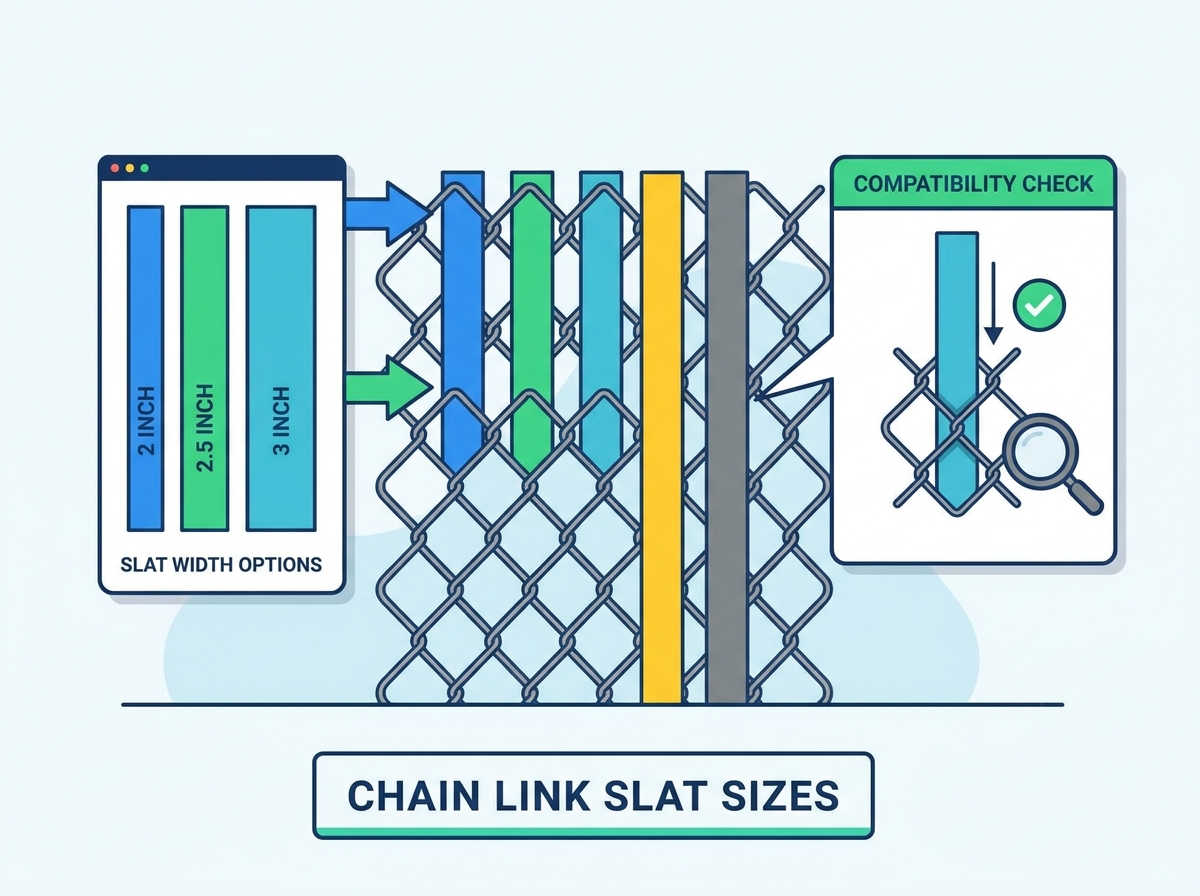
The vast majority of residential chain link fences installed in neighborhoods utilize a larger mesh size, typically ranging from 2.25 inches to 2.375 inches, woven from lighter 11-gauge or 11.5-gauge wire. This configuration offers the most forgiving internal clearance for privacy slat installation. Because the diamonds are wide, installers rarely encounter friction issues.
Compatible slat widths for these standard residential meshes generally fall between 1.25 inches and 1.33 inches. Because the mesh is relatively wide and the wire is thin, insertion is rapid. You can often drop these slats in with one hand. However, the trade-off for this ease of installation is a lower privacy yield and a looser fit. When standard-width slats are installed in a loose 2.375-inch mesh, the gaps between the edge of the slat and the wire remain visible. You can expect a privacy yield of roughly 75% to 85%. Additionally, the loose fit means the slats may rattle against the wire during high winds, creating ambient noise.
Commercial-grade chain link fences are engineered for security and durability, characterized by tighter tolerances. These fences almost exclusively utilize a strict 2-inch mesh woven from heavy 9-gauge wire. The robust construction minimizes flexibility in the fabric, making slat compatibility a rigid requirement rather than a flexible guideline. You will also frequently encounter twisted selvage (sharp, twisted wire ends) at the top of commercial fences, which requires careful slat insertion to avoid scratching the plastic.
Standard residential slats often fail in these applications. The combination of thick wire and a tight 2-inch diamond creates a narrow internal void. Attempting to force a standard 1.33-inch residential slat into a 9-gauge, 2-inch mesh will result in binding. Installers must specify slats explicitly designed for heavy-duty commercial compatibility. These slats are typically extruded with a slightly narrower profile or a thinner wall thickness to accommodate the reduced internal clearance without sacrificing structural rigidity.
Mini-mesh chain link is deployed in high-security environments, industrial facilities, and residential applications requiring strict adherence to local pool safety codes. These fences feature extremely tight diamond patterns, ranging from 1.25 inches to 1.75 inches, designed specifically to prevent toeholds and deny climbing access. The density of the wire makes these fences incredibly heavy and rigid.
The unique geometry of mini-mesh presents significant challenges for privacy upgrades. Standard privacy slats are physically too wide to pass through the diamonds. Modifying standard slats by trimming or forcing them is physically impossible and will destroy the material. Property owners must source specialized narrow slats engineered exclusively for mini-mesh dimensions. These narrow slats require precise manufacturing tolerances and take significantly longer to install due to the high density of the mesh pattern. You are essentially threading hundreds of thick plastic zip-ties through a steel net.
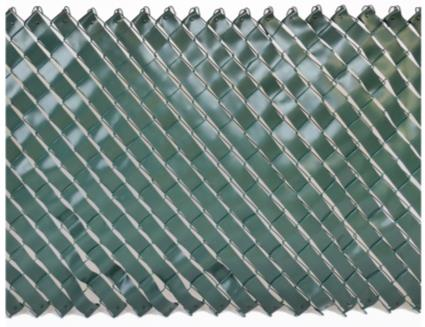
Standard privacy slats are manufactured in flat, tubular, or single-wall profiles. They are designed to slide vertically through the chain link diamonds, resting centrally within the mesh. The physical width of these slats leaves a deliberate gap between the edge of the plastic and the steel wire. Tubular designs feature a hollow core that provides a small amount of impact resistance, while flat slats are single extrusions.
This gap creates specific visibility angles. While looking straight at the fence may provide a solid visual barrier, looking at the fence from an oblique angle allows lines of sight through the mesh. Standard slats yield between 75% and 85% visual blockage. They represent the optimal choice for basic visual deterrents, defining property boundaries, concealing unsightly neighboring lots, and executing budget-conscious landscaping projects where total blackout privacy is not a strict requirement.
For applications demanding near-total visual obstruction, maximum privacy slats utilize specialized winged, V-shaped, or serrated edge designs. Unlike flat tubular slats, winged slats feature flexible side extensions that flare out once inserted into the diamond. These wings overlap the steel wire and seal the gaps that normally exist in standard installations. Installers sometimes use a light spray of soapy water to help these tight-fitting slats slide into place without catching.
Achieving 90% to 98% coverage requires strict adherence to mesh size requirements. Winged slats are highly engineered products that typically demand an exact 2-inch mesh to function properly. If installed in a larger 2.375-inch mesh, the wings cannot span the distance to the wire, defeating their purpose. If forced into a tighter mesh, the wings will crumple, bind, and permanently deform, ruining the visual aesthetic and the privacy rating.
Converting a porous chain link fence into a nearly solid wall drastically alters its aerodynamic profile. Chain link fabric is designed to allow wind to pass through with minimal resistance. When you install privacy slats, especially those rated for 90%+ coverage, you effectively transform the fence into a solid sail. This directly and severely increases the wind load exerted on the fence infrastructure.
Before installing high-density privacy slats, you must evaluate the existing structural framework. Terminal posts (corner and end posts) must be of sufficient diameter and set deeply into concrete footings that extend below the local frost line. Line post spacing should ideally be no more than 8 to 10 feet apart. Installing maximum privacy slats on an older fence with shallow footings, undersized posts, or rusted tension bands frequently results in the entire fence leaning, buckling, or blowing over during severe weather events.
Recommended Post Spacing for High-Privacy Slats
Fence Height | Maximum Line Post Spacing | Minimum Terminal Post Diameter |
|---|---|---|
4 Feet | 10 Feet | 2.375 Inches |
6 Feet | 8 Feet | 2.875 Inches |
8 Feet | 6 Feet | 3.0 Inches |
The base material of the privacy slat dictates its flexibility, longevity, and behavior during installation. High-Density Polyethylene (HDPE) is the industry standard for residential and commercial slats. HDPE offers excellent flexibility, allowing the slat to bend slightly during insertion without snapping. It also resists cold-weather embrittlement, making it ideal for northern climates where winter installations occur. PVC slats provide a stiffer profile with a glossy finish but become brittle in sub-zero temperatures, increasing the risk of shattering if forced into tight mesh.
Aluminum slats offer maximum rigidity and a distinct metallic aesthetic, often used in architectural or high-end security applications. Aluminum has absolutely zero tolerance for being forced into undersized mesh. If the internal clearance is too tight, the aluminum will scratch, dent, or jam completely. Regardless of the plastic chosen, ensure the product contains heavy-duty UV inhibitors. Without them, HDPE and PVC will rapidly shrink, warp, and fade under direct sunlight, compromising the fit within the chain link diamonds.
Top-locking slats feature a pre-drilled hole or a molded notch at the top of each individual piece. Once all slats are inserted into the fence fabric, a horizontal locking channel is threaded through these top holes, securing the entire run in place and ensuring a perfectly level top line. This prevents vandals from pulling the slats out from the top.
The primary sizing consideration for top-locking mechanisms is vertical alignment. The chain link diamonds must be uniform and undamaged. If one slat sits higher than the rest because it hit a rock at the bottom of the fence, the locking channel will not thread through the hole. Top-locking slats are generally incompatible with fences installed on steep, uneven grades where the top rail is stepped or heavily sloped. The rigid horizontal locking channel cannot easily follow aggressive elevation changes without binding or forcing the slats out of plumb alignment.
Bottom-locking systems utilize a horizontal track that is installed at the base of the fence fabric. The individual slats are then slid down through the diamonds until they snap securely into the bottom track. This system provides a clean top edge and prevents slats from being pulled upward or vibrating loose. The track usually features a one-way lip that locks the slat in permanently.
This mechanism is highly dependent on having a clear, unobstructed bottom margin. It reinforces the absolute necessity of the 3.5-inch vertical deficit discussed earlier. If the chain link fabric is installed too close to the ground, or if the soil is uneven, the bottom locking track cannot be installed straight. Debris, overgrown grass, and uneven concrete curbs will obstruct the track, preventing the slats from seating properly and locking into place.
Hedge slats are constructed using a stiff wire core wrapped with synthetic, UV-stabilized pine needles, designed to mimic the appearance of a natural evergreen hedge. This design offers a unique aesthetic alternative to standard extruded plastics and blends well into heavily landscaped yards.
From a sizing perspective, hedge slats are highly adaptable to various mesh sizes, typically accommodating anything from a 2-inch to a 2.375-inch diamond. The synthetic needles are compressible, allowing them to squeeze through the mesh during installation and expand once in place to block visibility. They still require specific gauge clearances. If the fence utilizes a very thick 9-gauge vinyl-coated wire, the friction during insertion can strip the synthetic foliage directly off the wire core, leaving bare metal exposed and ruining the product.
The physical consequences of installing oversized slats into undersized mesh are immediate and destructive. When a slat is too wide for the internal diamond clearance, the installer must use excessive force to drive it downward. This friction causes the plastic to heat up and stretch. Once installed, the tension remains trapped in the material.
Oversized slats will exhibit severe bowing, curving outward from the fence line rather than sitting flat. This bowing creates irregular gaps and ruins the uniform appearance of the fence. The constant compression stress accelerates plastic fatigue. When subjected to normal thermal expansion during hot summer months, the restricted slats have no room to expand, leading to buckling, cracking, and eventual snapping at the friction points. We call this the accordion effect, and it requires a complete tear-out to fix.
Privacy slats require a uniform grid to function correctly. Older fences frequently suffer from stretched diamonds, bent top rails, or sagging tension wires caused by climbing, fallen tree branches, or heavy snow loads. When a chain link diamond is stretched horizontally or vertically, its internal geometry changes, preventing the slat from sliding smoothly.
Attempting to install rigid slats into a damaged fence disrupts alignment and makes the installation of top or bottom locking channels nearly impossible. Mitigation strategies must be employed before slat insertion begins. This includes using a come-along winch to tighten the bottom tension wire, replacing severely damaged or crushed fabric sections, and ensuring the top rail is structurally sound. Slats will not fix a broken fence; they will only highlight its structural flaws.
Purchasing the correct volume of material requires precise calculation based on the mesh size. The standard formula for purchasing relies on the coverage yield per unit. Most standard slat bags or boxes are packaged to cover exactly 10 linear feet of a standard 2-inch mesh fence.
The mesh size directly alters this material yield. Larger mesh sizes, such as 2.375 inches, require fewer diamonds per linear foot. Consequently, a bag designed to cover 10 feet of 2-inch mesh might stretch to cover 11 or 12 feet of a 2.375-inch mesh fence. Conversely, tighter meshes require more slats per linear foot. Failing to calculate yield based on your specific mesh size will result in either a shortage of materials mid-project or excessive, costly leftover stock.
Manufacturers of high-quality privacy slats provide warranties against fading, cracking, and material defects. Forcing incorrect sizes into incompatible fences is classified as improper installation, which immediately voids all manufacturer warranties. The stress fractures caused by forcing a 1.33-inch slat into a tight commercial mesh are easily identifiable by warranty inspectors, who will often request photos of your mesh measurement before approving a claim.
Long-term maintenance is relatively simple but requires care. Slats should be cleaned periodically to remove dirt, algae, and environmental pollutants. Low-pressure washing is the approved method. Using high-pressure power washing wands at close range can easily dislodge the locking mechanisms, snap the plastic profiles, or strip the synthetic needles off hedge slats. Always wash at a downward angle to avoid driving water up under the locking channels.
Measure your existing chain link mesh inside-to-inside and verify the wire gauge before ordering any materials.
Order a small sample pack of chain link slat sizes to test insertion friction and visual coverage on your specific fence line.
Inspect your terminal posts and concrete footings to confirm they can handle the increased wind load of a 90% privacy barrier.
Clear all debris, overgrown grass, and soil buildup from the bottom four inches of the fence line to accommodate bottom-locking tracks.
With a strong background in precision plastic extrusion, Kenda combines large-scale manufacturing with product development expertise for fencing, garden privacy, and other outdoor plastic solutions. Its manufacturing operation includes more than 400 employees, 150 production lines, and a 56,500 m² facility, supporting customers across Europe, Australia, and the Americas
A: Installing narrower slats into a wider mesh is physically easy and will not cause binding. It significantly reduces the privacy yield. The gaps between the slat edges and the wire will be larger, allowing clear lines of sight through the fence at oblique angles, dropping the visual blockage well below 75%.
A: Yes, HDPE and PVC slats can be trimmed using heavy-duty pruning shears or a fine-toothed saw. Cutting slats removes the pre-drilled holes for top-locking systems. Bottom-locking slats can be cut from the top, but manual trimming across hundreds of slats is labor-intensive and rarely yields a perfectly uniform top line.
A: Slats can be installed on sloped fences, provided the chain link fabric was properly biased to follow the grade. Rigid top-locking channels often fail on steep slopes. Bottom-locking or self-locking friction slats are much better suited for uneven terrain where the top rail steps or angles aggressively.
A: Bowing is almost always caused by forcing a slat that is too wide into a tight mesh, or installing slats without the required bottom clearance. When the plastic expands in the heat, it has nowhere to go, causing it to buckle outward. Ensure your mesh size matches the slat specifications.
A: Find the cleanest, most intact section of the fence. Use a wire brush to remove heavy rust flaking, which can distort the measurement. Measure the inside distance between parallel wires. If the fence is severely rusted or the diamonds are stretched out of shape, slat installation may not be viable.
A: They can. Maximum privacy slats turn a porous fence into a solid wind barrier. If your fence has shallow concrete footings, undersized posts, or spans longer than 10 feet between posts, high winds can cause the posts to bend or uproot entirely. Always verify structural integrity first.


