
Outdoor Storage
Views: 0 Author: Site Editor Publish Time: 2026-10-26 Origin: Site


Installing a privacy fence permanently alters your property lines, dictates your future weekend maintenance schedule, and impacts your yard's security. Property owners frequently make fencing decisions based on immediate aesthetic preferences or initial contractor bids. This approach often leads to unexpected long-term labor, premature replacement, or climate-induced structural failures. You need to evaluate materials beyond the initial installation phase to make a structurally sound decision. This guide breaks down the climate resilience, maintenance realities, and installation complexities of a PVC vs wood fence. We will examine how different materials react to soil conditions, moisture levels, and extreme temperatures. By understanding the physical limitations and structural requirements of each option, you can select a barrier that meets your specific landscape demands and personal maintenance tolerance.
Upfront vs. Lifetime Cost: Wood offers a lower initial installation cost, but a PVC fence typically costs less over a 20-year period when factoring in the labor and materials required for staining, sealing, and rot repair.
Privacy Retention & Repairability: Wood fences naturally shrink over time, creating sightline gaps, but are incredibly cheap and easy to repair picket-by-picket. PVC maintains 100% privacy via interlocking panels, but repairing impact damage often requires replacing entire, expensive sections that may not perfectly color-match the older, sun-exposed fencing.
Climate Dependency: Material longevity is highly regional. Wood is susceptible to rot and warping in high-humidity environments, while extreme sub-zero temperatures can cause lower-grade PVC to become brittle and crack.
Maintenance Realities: Wood requires active, recurring chemical maintenance (staining/sealing every 2-3 years); PVC requires passive, periodic cleaning (power washing to remove algae or dirt).
Sustainability Trade-offs: Wood is a renewable resource but requires toxic sealants and has a shorter lifespan. PVC is a petroleum-based plastic that lasts longer but poses end-of-life landfill challenges.
Table of Contents
Choosing the right privacy fence involves more than appearance. Homeowners and contractors should consider privacy, safety, wind resistance, local regulations, and long-term maintenance requirements.
A privacy fence should reduce unwanted visibility while providing a secure outdoor boundary.
Important factors include:
Visual Privacy: Solid panels or closely fitted slats help block direct views.
Noise Reduction: Dense barriers may reduce some outdoor noise, depending on fence design and installation.
Pet Containment: Suitable fence height and ground clearance help prevent pets from escaping.
Wind Resistance: Posts and panels must meet local environmental requirements.
For garden screening applications, Kendash offers the 18mm Reinforced PVC Privacy Fence, featuring reinforced square-tube construction.
Fence installation must comply with local zoning rules and property requirements.
Before purchasing materials, verify permitted fence height, property boundaries, setback distances, and any Homeowners Association (HOA) restrictions.
Requirements vary by location, so written approval may be necessary before installation.
Fence material selection should reflect the expected service life and maintenance budget.
Wood fencing offers natural aesthetics and design flexibility. PVC fencing provides moisture resistance and typically requires less routine maintenance.
For buyers seeking privacy with a modern appearance, Kendash's Brushed Face Square Tube PVC Fence offers a reinforced alternative for residential and commercial gardens.
Wood fencing remains popular for its natural appearance and customization options. However, material type, climate, and maintenance practices influence its long-term performance.
Different wood species offer varying resistance to moisture, insects, and weathering.
Wood Type | Main Advantage | Key Consideration |
|---|---|---|
Pressure-Treated Pine | Affordable and widely available | May warp or split over time |
Western Red Cedar | Natural decay resistance | Color changes without maintenance |
Redwood | Attractive appearance and natural durability | Higher material cost in many markets |
Actual service life depends on wood grade, installation, treatment, and local climate.
Wood fences require regular inspection and surface protection.
Cleaning, staining, sealing, and replacing damaged boards help reduce weathering and deterioration.
Individual wooden pickets can often be repaired or replaced without removing an entire fence section.
Wood expands and contracts as moisture levels change. Over time, this movement may cause cracking, warping, or gaps between boards.
Humid environments can also increase the risk of fungal decay and insect damage.
Proper drainage, suitable fasteners, and appropriate wood treatment help extend fence life.
Wooden fence boards may shrink as they dry, creating visible gaps between adjacent pickets.
Overlapping board-on-board designs can help maintain privacy while allowing for natural material movement.
Alternatively, Kendash's PVC Privacy Fence Slat Kit offers a low-maintenance screening option for compatible metal fence structures.
Wood fencing is suitable for buyers who value natural materials and flexible design.
However, homeowners seeking lower maintenance and consistent manufactured finishes may prefer PVC fencing.
The final choice should consider installation requirements, climate conditions, budget, and long-term maintenance costs.
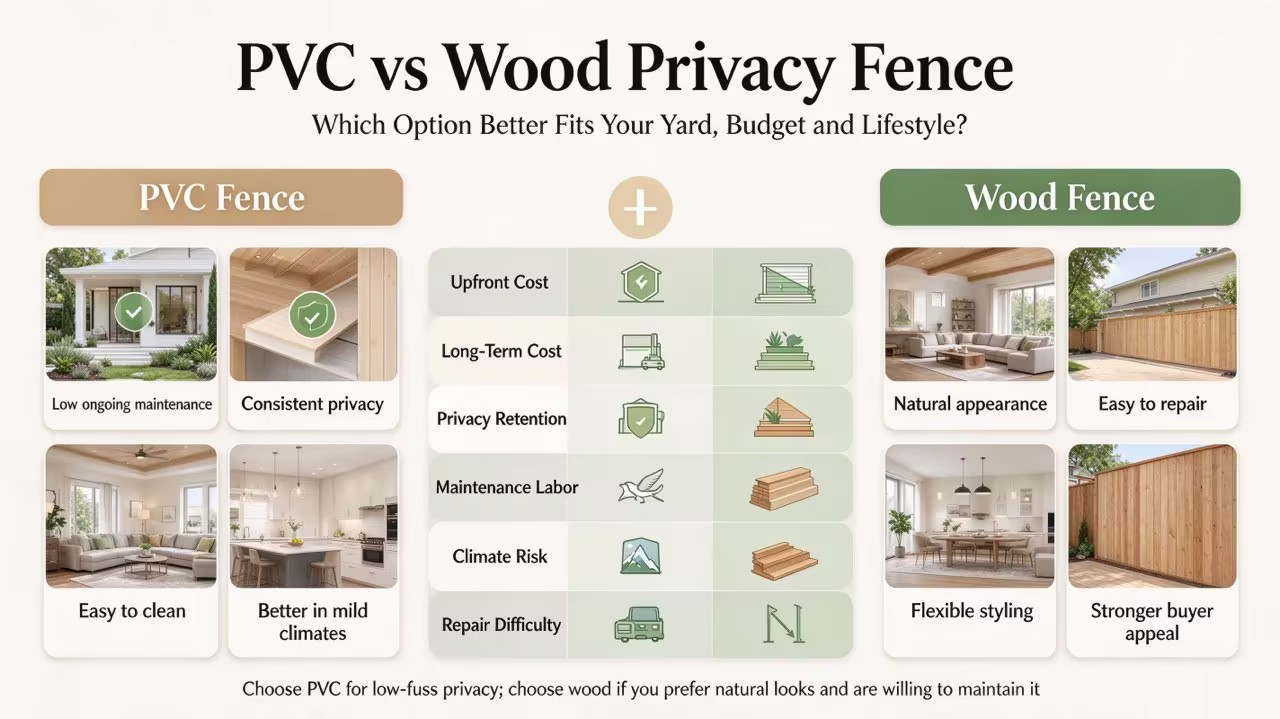
PVC fencing is a popular alternative to traditional wood fencing because it offers moisture resistance, relatively low maintenance, and a consistent appearance. However, material quality, climate conditions, and installation methods can affect long-term performance.
PVC fences are manufactured from polyvinyl chloride, often with stabilizers and additives to improve weather resistance.
Reinforced profiles and suitable wall thickness can improve rigidity and reduce deformation. Structural performance depends on the fence design, installation, and environmental conditions.
For outdoor privacy applications, Kendash offers the 18mm Reinforced Square Tube PVC Fence, designed for garden screening and boundary applications.
White PVC fencing is widely used for its clean appearance and relatively low heat absorption. Other popular colors include grey, black, brown, and wood-inspired finishes.
UV stabilizers help reduce discoloration and material degradation. Darker colors may absorb more heat, so buyers should evaluate UV resistance and thermal performance when selecting outdoor fencing.
PVC fences generally require less routine maintenance than wood fences.
Most surface dirt can be removed using water, mild detergent, and a soft brush. Regular painting or staining is usually unnecessary.
However, damaged PVC components may require replacement. Repair methods depend on the fence design and whether individual slats or panels can be removed.
Temperature changes can affect PVC fence performance. Extreme cold may increase impact sensitivity, while high temperatures can cause thermal expansion.
Proper installation should accommodate expected movement and environmental loads.
For residential and commercial applications, Kendash's PVC Privacy Fence Slat Kit provides a reinforced screening solution for compatible metal fence panels.
Wood and PVC fences offer different advantages in appearance, maintenance, repair, and environmental performance.
Wood fences offer a natural appearance but require periodic maintenance to protect against moisture, insects, and weathering.
PVC fences resist rot and do not normally require painting or staining. However, their lifespan depends on material quality, installation, and exposure conditions.
Wood fencing provides greater flexibility for painting, staining, and individual board replacement.
PVC fencing offers consistent factory-made colors and a variety of privacy designs. Depending on the product, reinforced slats and screening panels can provide different levels of visibility control.
Feature | Wood Fence | PVC Fence |
|---|---|---|
Appearance | Natural wood texture | Consistent manufactured finish |
Maintenance | Regular staining or sealing may be needed | Periodic cleaning |
Moisture Resistance | May rot without suitable protection | Resistant to rot |
Color Options | Easy to paint or stain | Factory colors and finishes |
Repairs | Individual boards often replaceable | Depends on panel or slat design |
Climate Concerns | Moisture, insects, warping | Thermal expansion, cold-weather impact |
Privacy | Depends on board arrangement | Depends on panel or slat coverage |
Wood is a renewable material when sourced from responsibly managed forests, but treatments and maintenance can affect its environmental footprint.
PVC is durable and potentially recyclable through suitable facilities, although recycling availability varies by region. Its production and disposal also have environmental impacts.
A complete sustainability comparison should consider material sourcing, expected service life, maintenance, and end-of-life disposal.
PVC fencing is a practical option for buyers prioritizing low maintenance, moisture resistance, and consistent appearance.
Wood may be more suitable for projects requiring natural materials or frequent aesthetic changes.
For distributors, contractors, and property developers, the best choice depends on installation conditions, design requirements, maintenance budgets, and long-term project costs.
Selecting the right barrier requires balancing your tolerance for ongoing maintenance against your desire for permanent privacy. You must evaluate your local climate, soil conditions, and neighborhood regulations before digging the first post hole.
Pull your property survey to verify exact boundary lines before ordering materials or scheduling contractors.
Submit your proposed fence design and material choice to your HOA architectural review committee for written approval.
Call your local utility marking service to flag underground gas, water, and electrical lines along the proposed fence path.
Review the manufacturer's warranty documentation to understand exactly which maintenance practices might void your coverage.
A: A high-quality vinyl installation can easily last 20 to 30 years with minimal degradation. Wood lifespans vary heavily by species and maintenance. Pressure-treated pine typically lasts 10 to 15 years. Premium cedar or redwood can reach 20 to 30 years if you strictly maintain the surface and apply water-repellent sealants regularly.
A: Wood is significantly easier to repair. You can replace a single damaged picket or rail using basic hand tools. Vinyl repairs usually require disassembling and replacing an entire panel section. Finding an exact color match for older, sun-faded vinyl can also be challenging when installing a brand-new replacement panel.
A: Extreme sub-zero temperatures can cause lower-grade vinyl to become brittle and susceptible to impact damage. However, premium virgin vinyl manufactured with impact modifiers performs exceptionally well in cold climates. Always verify the cold-weather rating and flexibility of the specific product before installation in northern regions.
A: You should not paint or stain vinyl. The material is designed to be maintenance-free, and paint does not adhere well to its smooth, non-porous surface. Applying paint often voids the manufacturer's warranty and introduces the peeling and chipping problems you originally sought to avoid by choosing plastic.
A: Both materials add value by enhancing privacy and security. Vinyl often appeals to buyers seeking a turnkey, low-maintenance home. Wood appeals to buyers who prefer natural aesthetics and traditional landscaping. The added value largely depends on the neighborhood standard and the fence's current structural condition.
A: Both solid privacy fences act like sails in high winds. Vinyl panels are engineered to flex slightly, but extreme gusts can blow out entire sections if the rails are not seated deeply enough in the posts. Wood is rigid and relies entirely on the depth and concrete footing of its posts to withstand wind loads.


