
Outdoor Storage
Views: 0 Author: Site Editor Publish Time: 2026-07-27 Origin: Site


Purchasing outdoor storage based solely on a "gallon" rating frequently results in a mismatch between the box's physical footprint and the actual items needing storage. Consumers struggle to visualize abstract volume metrics. They often fail to account for the difference between exterior dimensions and usable interior space. A 100-gallon rating sounds massive until you try to fit a standard patio umbrella inside and realize the box is six inches too short.
This comprehensive deck box size guide establishes a concrete framework for evaluating storage options. We translate abstract gallon capacities into practical dimensions. You will learn how to match specific outdoor items to required interior measurements. We also explore how to navigate the trade-offs between storage capacity, spatial constraints, and secondary utility like patio seating.
Volume vs. Fit: A high gallon capacity does not guarantee an item will fit; the longest interior dimension dictates whether items like patio umbrellas or standard brooms can be stored.
The Cushion Rule: Standard patio chair cushions require significantly more volume than expected due to trapped air and rigid foam; 100–149 gallons is the baseline for a full dining set.
Interior Discrepancies: Thick-walled materials (like double-wall resin or solid wood) reduce interior dimensions by up to 10% compared to the advertised exterior footprint.
Brand-Specific Baselines: Popular manufacturers (such as Lifetime, Keter, and Rubbermaid) design around specific volume sweet spots (e.g., 80, 116, 130, and 150 gallons) rather than clean 50-gallon increments.
Clearance Requirements: Proper sizing must account for lid swing arcs, hinge clearance against walls, and operational accessibility in tight configurations like balconies or corners.
Table of Contents
Manufacturers advertise exterior dimensions primarily for shipping logistics and patio footprint planning. Interior dimensions dictate actual storage viability. A box might measure 48 inches long on the outside. Once you account for wall thickness and internal hinge mechanisms, you might only have 43 inches of usable length. Relying strictly on the gallon rating obscures these critical spatial realities. When you are on a job site or setting up a residential patio, those missing five inches determine whether your gear stays dry or sits out in the rain.

Volume distribution plays a massive role in usability. A tall, square 80-gallon box serves a fundamentally different purpose than a long, shallow 80-gallon box. Both hold the same total volume. The tall box excels at holding bags of potting soil, tall pool chemicals, or stacked bags of charcoal. The long box easily accommodates folding chairs, long-handled gardening tools, or collapsed canopy tents. You must match the shape of the box to the shape of your gear. Buying a square box for long tools is a rookie mistake that happens constantly.
Construction materials actively eat into usable interior space. Blow-molded resin features double-wall construction for structural integrity. Wicker boxes often rely on internal steel frames. Solid teak requires thick panels to prevent warping. These robust materials reduce the internal cavity. You lose several inches of storage space to the structural shell itself. If you buy a single-wall plastic box, you get more interior space, but the box will likely warp under the summer sun. Double-wall construction is necessary for durability, but you must account for the lost interior volume.
Common brand sizing increments deviate from generic estimations. You rarely find a perfect 100-gallon box. Instead, you encounter specific industry standards. Rubbermaid frequently produces 83-gallon models. Lifetime focuses heavily on 116-gallon and 130-gallon variants. Understanding these specific benchmarks helps you align your storage needs with actual market availability. Stop looking for a generic size and start planning around the actual dimensions manufactured by the major brands.
Material Type | Wall Thickness Impact | Durability Profile | Interior Volume Loss |
|---|---|---|---|
Single-Wall Resin | Minimal (1/8 inch) | Prone to warping, low weight capacity | 1-2% |
Double-Wall Resin | High (1 to 1.5 inches) | Excellent rigidity, supports seating | 8-10% |
Steel-Framed Wicker | Moderate (0.5 to 1 inch) | Good aesthetics, rust risk if scratched | 5-7% |
Solid Wood (Teak/Cedar) | High (0.75 to 1.5 inches) | Heavy, requires annual sealing | 8-12% |
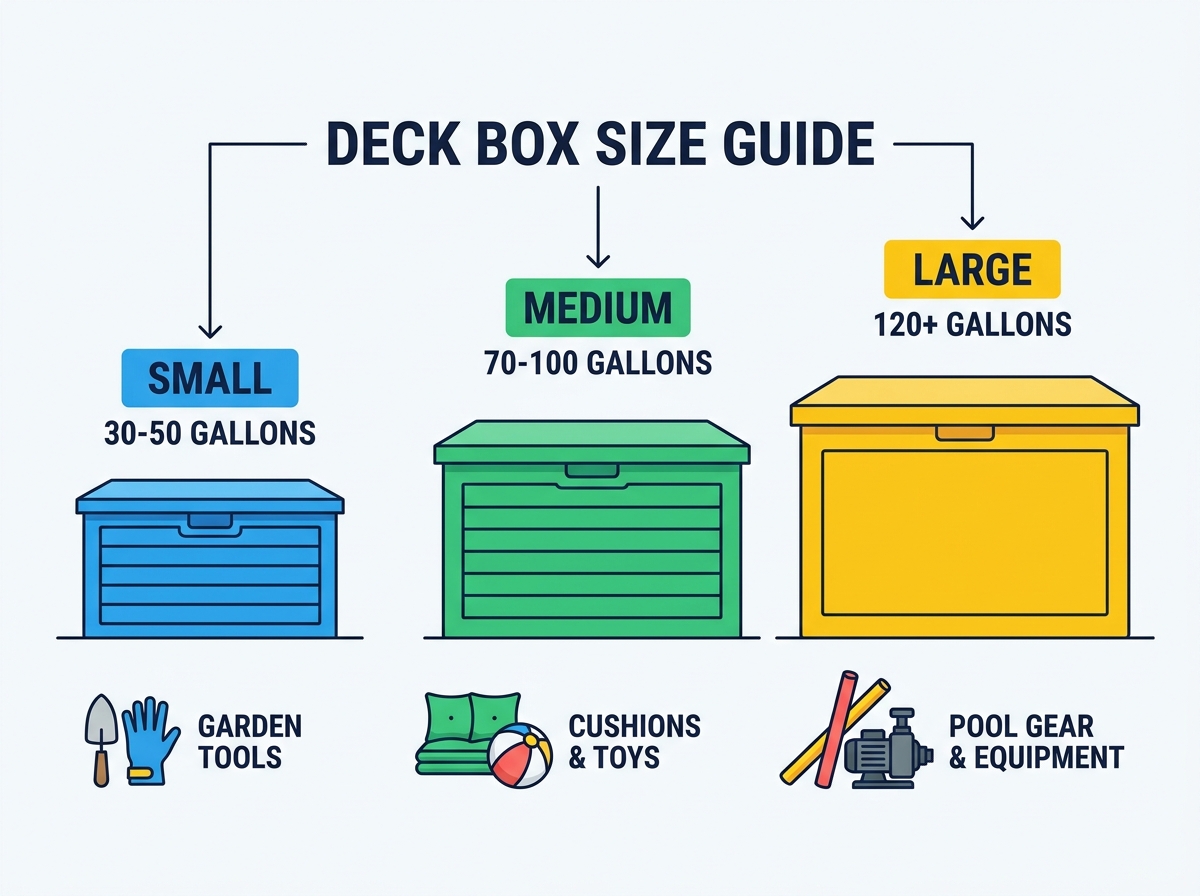
Categorizing storage options into distinct capacity tiers simplifies the selection process. Each tier serves specific outdoor living requirements. Do not guess your tier. Measure your largest items and match them to the categories below.
Small units typically measure around 22 inches long, 17 inches wide, and 22 inches high. They often take the form of patio end tables or compact corner seats. These work perfectly for hand gardening tools, single seat cushions, or hose reels. Many homeowners use them near entryways for patio shoes or secure delivery drop-offs. However, they cannot fit standard long-handled tools, large lawn toys, or multiple thick cushions. If you try to stuff a standard lounge cushion into a 30-gallon box, you will break the hinges.
Medium boxes generally measure 46 inches long, 18 inches wide, and 22 inches high. Popular models include the Rubbermaid 83-Gallon and Lifetime 80-Gallon units. This size represents the sweet spot for balcony storage. They fit neatly under standard windowsills. You can store standard patio seating cushions for two to four chairs. They easily hold kids' outdoor lawn toys, folding lawn chairs, and medium-sized pool floats. This is the most common size for suburban patios that do not have massive sectional sofas.
Large storage units measure approximately 54 inches long, 26 inches wide, and 28 inches high. Common examples include the Keter Borneo 110-Gallon and Lifetime 130-Gallon models. This tier accommodates full dining chair cushion sets. You can store large patio accessories, multiple bags of potting soil, or bulky pool equipment. At this size, the boxes become heavy enough to require two people to move when empty. Do not buy this size if you plan to move it around the yard frequently without emptying it first.
Oversized units exceed 60 inches in length, 28 inches in width, and 30 inches in height. The Lifetime 150-Gallon and Keter 230-Gallon dominate this category. They easily hold deep-seating sectional sofa cushions and disassembled patio umbrellas. You can even store bicycles or push mowers. This size blurs the line between a deck box and a horizontal storage shed. It requires significant dedicated patio real estate. Ensure your deck joists can handle the weight of a fully loaded 200-gallon box before installation.
Successful sizing requires a methodical approach to measurement. Start by identifying the most rigid, inflexible items you plan to store. Measure the exact length of your umbrella pole. Check the width of your solid foam seat cushions. These hard dimensions dictate your absolute minimum interior requirements. A box can have 200 gallons of capacity, but if it is only 45 inches long, a 50-inch umbrella pole simply will not fit.
Perform a physical stacking audit for soft goods. Gather all the fabric items you intend to store. Stack your patio cushions exactly as you would place them in the box. Compress them slightly to simulate the closed lid. Measure the resulting cube. Multiply the length, width, and height to find your minimum required interior volume. This physical test prevents the common mistake of underestimating how much space trapped air requires. Fabric and foam do not compress as much as you think they do.
Spatial clearance around the exterior matters just as much as interior capacity. If you place the box under a window, ensure the exterior height does not block your view. Check that it does not interfere with low windowsills. When placing units against siding or stucco, account for rear hinge clearance. The lid must open fully without scraping the wall. In tight balconies, leave adequate walkway flow. You need enough front clearance to access stored items comfortably without stepping off the patio edge.
Sizing up often provides the secondary benefit of bench seating. Many medium and large boxes feature reinforced lids designed to support adult weight. You must verify the manufacturer's static weight limit before using it as furniture. A box rated for 400 pounds easily seats two adults. This dual-purpose utility saves valuable patio space, making a larger footprint easier to justify. Never assume a plastic lid can hold a person unless the manufacturer explicitly states a weight rating.
Portability becomes a critical factor for boxes exceeding 100 gallons. If you need to move the unit seasonally, look for heavy-duty casters or molded side handles. A fully loaded 130-gallon box weighs several hundred pounds. Without proper handles or wheels, repositioning it requires completely emptying the contents first. Dragging a loaded box across a concrete patio will grind down the plastic base and eventually cause bottom-out failure.
Internal organization features directly impact usable volume. Built-in dividers, storage nets, or shelving help separate pool chemicals from fabric cushions. However, these features consume interior space. A divider might reduce your maximum continuous length by an inch or two. Factor these organizational tools into your initial measurements to ensure your largest items still fit. If you need maximum continuous length for an umbrella, remove the internal dividers.
The patio umbrella trap catches many buyers off guard. People purchase massive, high-gallon boxes assuming everything will fit. They fail to check the interior length. Standard umbrella poles often exceed 50 inches. If your box measures 48 inches internally, the umbrella stays outside in the rain. Always measure your longest item first. Do not trust the gallon rating to solve linear length problems.
Buying a box that is slightly too small leads to overstuffing. Forcing the lid down on compressed cushions bows the plastic over time. This warping breaks the weather-resistant seal along the rim. Water intrusion inevitably follows, ruining the exact items you tried to protect. Always size up if your stacking audit falls within 10% of the box's maximum capacity. A warped lid is a ruined box.
Oversized boxes carry compliance risks in regulated communities. Units exceeding 150 gallons often violate Homeowner Association height restrictions. They can also exceed balcony weight limits in apartment complexes. A fully loaded 230-gallon box creates a massive point load on a wooden deck. Verify your structural limits and local regulations before purchasing extra-large units. You do not want to buy a massive storage unit only to receive a removal notice from your property manager.
Recognize when a deck box no longer serves your needs. If you need to store heavy yard machinery, push mowers, or multiple large trash bins, stop looking at deck boxes. Transition to a utility or horizontal storage shed. Sheds offer front-opening doors, eliminating the need to lift heavy equipment over a high top rim. Lifting a 60-pound generator over a 30-inch plastic rim is a fast way to injure your back and destroy the storage unit.
Selecting the right deck box size begins with understanding your actual storage requirements rather than relying only on gallon ratings. Measuring your equipment, checking interior dimensions, and planning for future storage needs will help you choose a deck box that provides lasting convenience, weather protection, and efficient organization.
About KENDA
KENDA is a professional manufacturer of outdoor storage products, offering durable resin deck boxes, storage cabinets, and storage sheds for residential and commercial applications. Designed with weather-resistant materials, practical storage solutions, and easy assembly, KENDA helps customers keep outdoor spaces organized, protected, and maintenance-free.
Measure your longest and largest items before selecting a deck box.
Compare interior dimensions rather than relying only on gallon capacity.
Leave extra storage space for airflow and future purchases.
Ensure adequate clearance for lid opening and everyday access.
Before choosing a deck box, compare your storage needs, available outdoor space, interior dimensions, and future capacity requirements to find the most practical long-term storage solution.
A: You generally need a large deck box ranging from 100 to 130 gallons. Standard dining chair cushions contain rigid foam and trap air. A 116-gallon unit typically provides enough interior height and width to stack six cushions without compressing them enough to warp the lid.
A: It depends entirely on the interior length, not the gallon capacity. Most standard disassembled umbrella poles require at least 50 to 54 inches of clearance. You must check the specific manufacturer's interior length specifications. Many 100-gallon boxes are too short for standard umbrellas.
A: Exterior dimensions measure the total footprint, including the lid overhang and hinges. Interior dimensions measure the actual usable storage space inside. Thick double-wall resin or wood construction can reduce interior dimensions by several inches compared to the advertised exterior size.
A: Yes, many 50-gallon units are designed specifically as patio end tables or single-seat benches. However, you must verify the manufacturer's static weight capacity. Not all small boxes have reinforced lids capable of supporting an adult's weight safely.
A: Most resin deck boxes are highly water-resistant but not entirely waterproof. They shed rain effectively when closed properly. However, overstuffing the box can warp the lid, breaking the seal. Submersion or driving rain driven by high winds can occasionally force moisture inside.
A: Consider a horizontal shed when your storage needs exceed 150 gallons, or when storing heavy items like push mowers and trash bins. Sheds feature front-opening doors, allowing you to roll heavy items inside rather than lifting them over the high rim of a deck box.


