
Outdoor Storage
Views: 0 Author: Site Editor Publish Time: 2026-08-13 Origin: Site


Upgrading an existing chain-link fence for privacy is a common requirement for commercial facilities, industrial sites, and residential properties, but selecting the wrong material can lead to structural failure or rapid degradation. Property managers and homeowners must decide between rigid privacy slats and flexible screen fabric. This decision extends beyond aesthetics, directly impacting wind load dynamics, installation labor, long-term maintenance, and overall project viability. This guide provides an evidence-based comparison of privacy slats vs screen options, evaluating both materials across durability, opacity, structural risk, and installation realities to facilitate a confident purchasing decision. We look at real-world site conditions, material behavior under stress, and the physical demands of installation.
Structural Risk is the Primary Constraint: Both slats and screens significantly increase the wind resistance of a chain-link fence. Failing to assess existing post strength and wind load capacity can result in catastrophic fence failure.
Permanence vs. Flexibility: Privacy slats offer a rigid, long-term architectural integration (lasting 10–25 years), whereas screen fabrics (windscreens) provide a highly customizable, rapid-deployment solution with a shorter lifespan (3–7 years).
Labor, Installation, and Contractor Bias: Screen fabric is rolled out and secured with zip ties, making it highly efficient for long fence lines. Slats require time-intensive, piece-by-piece manual insertion, leading many contractors to heavily favor screens over slats.
Opacity Limitations: High-density screen fabric can achieve up to 98% visual blockage uniformly, though side-angle visibility can be an issue. Slats typically max out at 75–90% opacity, as visibility remains possible through the angled gaps of the chain-link weave.
Table of Contents
Before purchasing any privacy material, you must evaluate the structural integrity of your current chain-link framework. A standard chain-link fence is highly porous. It allows high-velocity winds to pass through the wire mesh with minimal resistance. When you install privacy materials, you effectively transform a porous boundary into a solid sail. This drastically alters the aerodynamic profile of the fence.
You need to measure the line post diameter, check the terminal post depth, and inspect the concrete footing integrity. Standard residential fences often use 1-5/8 inch line posts driven shallowly into the ground. These posts may hold up bare wire, but they will quickly bend or snap under the wind pressure generated by a solid privacy barrier. Commercial fences typically utilize 2 inch, 2.5 inch, or even 3 inch line posts set deep in concrete, making them far better suited for aftermarket privacy upgrades. If your posts are set in loose soil rather than concrete, adding a solid surface area will cause the fence to lean after the first major storm.
You also need to inspect the top rail and tension wire. A missing bottom tension wire allows the chain-link fabric to flap in the wind. If you attach a screen to a loose mesh, the constant movement will destroy the grommets and tear the fabric. Ensure the framework is rigid and fully tensioned before proceeding.
Material selection depends heavily on your primary site objective. You must differentiate between absolute visual privacy, security deterrence, dust control, and temporary construction screening. If your goal is to prevent dust and debris from leaving an active construction site, flexible fabric is the standard choice. It catches airborne particles effectively and can be removed when the project ends.
If your goal is permanent residential aesthetics or long-term security deterrence, rigid inserts make more sense. Property owners seeking to block the view of heavy machinery or inventory yards permanently will benefit from the architectural permanence of rigid materials. Establishing this primary objective early prevents mismatching the product to the environment.
Consider these site assessment steps before making a decision:
Identify the primary wind direction and average wind speeds in your geographic area.
Determine if the installation is temporary (under 2 years) or permanent (10+ years).
Assess the level of physical impact the fence will endure from landscaping equipment or pedestrians.
Verify if local zoning laws require specific opacity limits for perimeter fencing.
Privacy slats are rigid, vertical inserts designed to slide directly into the diamond-shaped gaps of a chain-link weave. Manufacturers typically extrude these from High-Density Polyethylene (HDPE) or fabricate them from aluminum. HDPE is the industry standard due to its flexibility, impact resistance, and ability to hold color under harsh weather conditions.
You will encounter several distinct styles on the market. Standard tubular slats are hollow and provide basic coverage. Bottom-locking slats feature a horizontal base channel that secures the vertical pieces in place, keeping the fence line even. You slide the channel horizontally through the bottom diamond, then snap each vertical piece into the track. Top-locking slats function similarly but secure the pieces near the upper rail. Winged slats include flexible, serrated edges on both sides of the rigid core. These wings grip the wire mesh tightly and flare out to block the residual light gaps, offering the highest opacity in this category. Hedge-style slats mimic the look of natural pine needles, blending into wooded landscapes.
Privacy screen fabric, often called windscreen, is a flexible textile that attaches to the exterior face of the fence. Manufacturers produce these screens from knitted polyethylene, vinyl-coated polyester, or heavy-duty canvas. Knitted polyethylene is the most prevalent due to its balance of weight, breathability, and weather resistance. The lock-stitch knitting process ensures that if the material is punctured, the hole will not run or unravel.
Screens are categorized by their density ratings, which indicate the percentage of light and wind they block. Common ratings include 85%, 90%, and 98% blockage. The edge construction is critical for longevity. High-quality screens feature heavily reinforced hems made from 3-ply tape and brass grommets spaced every 12 to 18 inches. Brass is preferred over aluminum because it resists corrosion when exposed to rain and humidity.
Screens also offer extensive commercial customization capabilities. Facilities can order screens with custom printed logos, site branding, and exact dimensional cuts. Rigid inserts cannot accommodate printed graphics, making fabric the default choice for branded perimeters.
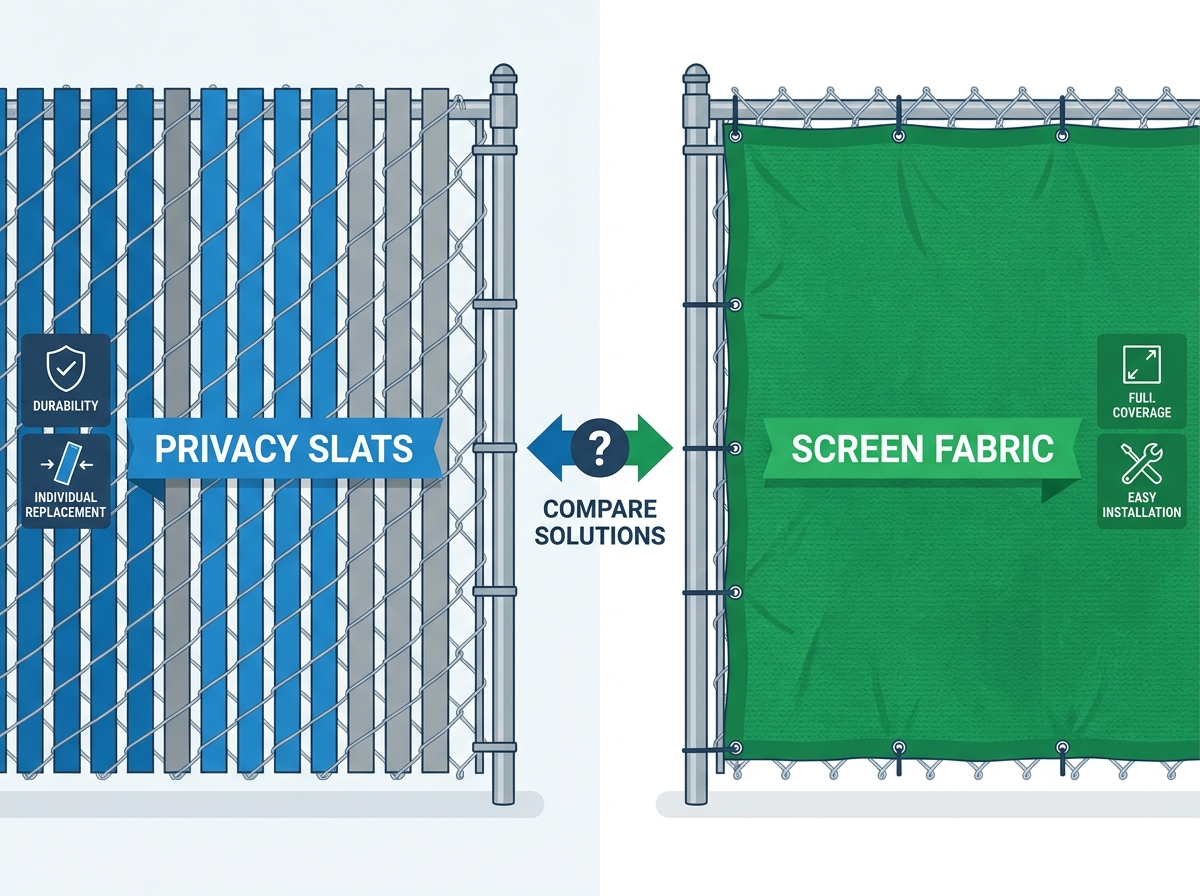
Evaluating opacity requires looking past manufacturer marketing claims. A fabric rated for "90% blockage" does not guarantee absolute privacy under all conditions. Lighting conditions and viewing angles heavily influence actual visibility. If the sun is positioned behind the fence, backlighting will illuminate objects on the other side, rendering the screen semi-transparent. You can often see the silhouettes of people and equipment clearly through a backlit screen.
You must also account for side-angle vulnerability. When you look directly at a knitted screen, the mesh appears solid. However, if you view the same screen from an oblique angle, the alignment of the knitted fibers creates clear sightlines through the material. This allows pedestrians walking parallel to the fence to see into the property easily.
Rigid inserts face different opacity limitations. The physical size of the chain-link diamond dictates the residual gap. Standard chain-link mesh comes in 2-inch, 2.25-inch, and 2-3/8-inch diamonds. When you drop a standard 1.25-inch wide slat into a 2.25-inch diamond, the slat cannot fill the entire space. The geometry of the wire forces small, zigzagging gaps along the entire height of the fence. Even with winged variations, achieving true 100% opacity is structurally impossible with vertical inserts. You will always have pinholes of light passing through the knuckles of the wire.
Weather resistance dictates the replacement cycle of your privacy solution. HDPE slats generally feature integrated UV inhibitors mixed directly into the polymer during the extrusion process. This prevents fading, cracking, and brittleness over decades of direct sunlight exposure. They also withstand physical impacts exceptionally well. If a landscaper hits the bottom of the fence with a weed whacker, a rigid HDPE insert will scuff but remain intact. They do not absorb water, making them immune to mold and mildew.
Screen fabrics are highly susceptible to UV breakdown. Even with UV-stabilized coatings, the constant exposure to sun and wind causes the synthetic fibers to dry rot, fray, and lose their tensile strength over a 3 to 7-year horizon. Fabric is also vulnerable to physical damage. Flying debris, sharp branches, or careless landscaping equipment can easily puncture or tear the mesh. Once a tear begins, wind tension will rapidly expand the hole, compromising the entire panel.
The installation mechanics for these two materials are entirely different. Screen installation is a rapid, straightforward process. A crew unrolls the fabric along the fence face, pulls it taut, and secures it to the top, bottom, and line posts using heavy-duty zip ties or hog rings through the brass grommets. Installers usually hang the fabric temporarily with S-hooks, tension it from the corners, and then fasten the grommets sequentially. A small crew can cover hundreds of feet of perimeter in a single afternoon.
Slat installation is an exercise in repetitive manual labor. Workers must slide each individual piece down through the wire mesh from the top of the fence. Friction between the plastic and the galvanized wire slows the process. If the fence uses a bottom-locking channel, the installer must perfectly align the bottom of every single piece into the track. If the wire mesh is slightly bent or damaged, the slat will bind, requiring the installer to force it through with pliers. This process takes exponentially longer than hanging fabric.
This stark difference in labor time creates a significant contractor bias. Many fence contractors actively push screen fabrics because they allow for faster deployment and higher labor margins. They can complete the job quickly and move to the next site. Contractors may discourage the use of rigid inserts, citing them as outdated, simply to avoid the tedious manual labor involved in the insertion process.
Visual permanence plays a major role in material selection. Rigid inserts look like a deliberate, permanent architectural feature. They integrate cleanly into the fence structure. Screen fabrics often carry a "temporary" or "construction site" aesthetic, regardless of their quality. The fabric eventually sags, fades, or wrinkles, which detracts from the property's curb appeal.
You must also consider Homeowner Association (HOA) and municipal zoning compliance. Many local jurisdictions and HOAs explicitly restrict the use of canvas or fabric screens in residential neighborhoods, classifying them as temporary construction materials. Conversely, these same governing bodies frequently permit rigid inserts as permanent, code-compliant fixtures.
When comparing these solutions, you must look at both the initial capital required and the long-term viability of the material. Screen fabric requires a significantly lower initial investment for both materials and labor. It is budget-friendly on day one. Rigid inserts demand a higher upfront investment due to manufacturing costs and the extensive labor required for installation.
However, the long-term replacement cycles alter the overall value equation. Over a 15-year period, a property owner will likely need to replace screen fabric two to three times due to UV degradation, wind tearing, or fading. Each replacement requires purchasing new material and paying for labor. A single installation of rigid HDPE inserts will typically persist through that entire 15-year window with zero replacement needs.
Repair scenarios highlight the modularity of each system. If a vehicle backs into a fence or vandals damage a section, repairing rigid inserts is highly localized. You simply pull out the three or four broken pieces and slide in new ones. The repair is inexpensive, perfectly matches the surrounding fence, and requires no special tools.
Repairing a torn screen is far more problematic. You cannot seamlessly patch knitted polyethylene. If a large tear occurs in the middle of a 50-foot panel, you often have to remove and replace the entire panel to maintain aesthetic uniformity. Even if you replace the panel, the new fabric will be noticeably darker than the older, sun-faded fabric adjacent to it.
Material Comparison Summary
Feature | Rigid Inserts | Flexible Fabric |
|---|---|---|
Material Composition | Extruded HDPE or Aluminum | Knitted Polyethylene or Vinyl-Coated Polyester |
Expected Lifespan | 10 to 25 Years | 3 to 7 Years |
Installation Speed | Slow (Piece-by-piece manual insertion) | Fast (Rolled out and zip-tied) |
Maximum Opacity | 75% to 90% (Depending on diamond size) | Up to 98% (Subject to side-angle visibility) |
Custom Branding | Not Available | Available (Custom printed logos and graphics) |
Repair Modularity | High (Replace individual pieces) | Low (Requires replacing entire panels) |
The most severe implementation risk for either option is post failure due to excessive wind load. Chain-link industry guidance explicitly warns that altering the porosity of a fence requires a structural assessment. When wind hits a solid barrier, the force transfers directly to the line posts. If the posts are set in shallow dirt or are made of thin-walled steel, they will bend at the ground line during the first major storm.
You must implement mitigation strategies if your posts are undersized. For screen fabrics, you can cut half-moon wind-slits into the material every few feet. These slits act as pressure relief valves, allowing high-velocity gusts to pass through without tearing the fabric or bending the posts. For rigid installations, you cannot cut slits. Instead, you may need to retrofit the fence by adding horizontal mid-rails to distribute the force, or by driving internal steel sleeves down into the existing line posts to stiffen them.
Wind Load Mitigation Strategies
Mitigation Technique | Application | Effectiveness |
|---|---|---|
Half-Moon Wind Slits | Screen Fabric Only | Relieves localized pressure during high gusts. Reduces opacity slightly. |
Internal Steel Sleeves | Both Systems | Strengthens existing line posts without digging new footings. Highly effective. |
Horizontal Mid-Rails | Both Systems | Distributes wind force evenly across the fence line. Prevents mesh bowing. |
Deepened Concrete Footings | Both Systems | Prevents posts from leaning in saturated soil. Required for permanent upgrades. |
Purchasing materials without measuring your exact fence dimensions leads to frustrating installation failures. You face a high risk of buying rigid inserts that do not fit your existing diamond gauge. For example, industrial sites often use a heavy 9-gauge wire woven into a tight 2-inch diamond for security. If you attempt to force standard inserts designed for a 2.25-inch residential mesh into a tight commercial weave, they will bind, bend, and refuse to slide down.
Measuring the exact fence height is equally critical. Fences are rarely perfectly level. If you order screen fabric that is exactly 72 inches tall for a 6-foot fence, the fabric will likely drag on the ground in low spots. Ground contact causes the fabric to wick up moisture, accelerating rot and accumulating mud. You should order fabric slightly shorter than the fence height to maintain a clean gap at the bottom. For rigid inserts, incorrect height measurements will prevent the bottom-locking channels from aligning properly, ruining the installation.
The choice between rigid inserts and flexible fabric hinges on your required lifespan, aesthetic preferences, and the structural capacity of your existing framework. Neither solution is universally superior. You must align the material characteristics with your specific site demands to avoid premature failure or wasted labor. Choose privacy screen fabric for rapid deployment, temporary construction needs, dust control, custom site branding, or when covering vast perimeters where manual insertion is unfeasible. Choose privacy slats for permanent residential installations, high-impact industrial areas, strict HOA environments, and long-term architectural integration.
For projects that require a more tailored approach, Kenda provides chain-link fence privacy solutions that help buyers evaluate material options according to privacy goals, installation conditions, and long-term performance requirements. By considering both product characteristics and real-world site conditions, Kenda helps customers make more practical decisions for residential, commercial, and industrial fencing projects.
To execute a successful privacy upgrade, follow these next steps:
Measure your chain-link diamond size and wire gauge to ensure material compatibility.
Dig down at the base of a line post to verify the depth and condition of the concrete footing.
Consult your local building codes and HOA guidelines regarding wind load requirements and opacity restrictions.
Order materials based on the exact linear footage, accounting for a 2-inch ground clearance to prevent moisture damage.
A: Yes, it can cause severe damage if the fence is not structurally rated for the added wind load. Adding privacy materials turns a porous wire mesh into a solid sail. This exponentially increases the wind pressure on the line posts, which can cause them to bend or snap at the base during storms.
A: Screen fabric requires a lower initial investment for both materials and labor. However, because fabric degrades and tears, it usually requires replacement every few years. Rigid inserts require a higher upfront investment but offer better long-term value since they rarely need replacing.
A: Yes, visibility is still possible. Backlighting from the sun can illuminate objects behind the screen. Additionally, viewing the knitted mesh from a sharp side angle aligns the fibers in a way that creates clear sightlines through the material.
A: High-density polyethylene (HDPE) slats typically last 10 to 25 years because they are highly resistant to physical impact and UV degradation. Screen fabrics usually last 3 to 7 years before sun exposure and wind tension cause them to dry rot or tear.
A: They are not technically difficult, but the process is highly labor-intensive. You must slide each piece individually down through the wire mesh. The friction and repetitive manual labor make it a very time-consuming task, which is why many contractors prefer hanging rolled fabric instead.
A: You should always check your local municipal codes. Altering the opacity and wind load profile of an existing fence often triggers zoning regulations. Many Homeowner Associations also have strict rules that prohibit temporary fabric screens while allowing permanent rigid inserts.


